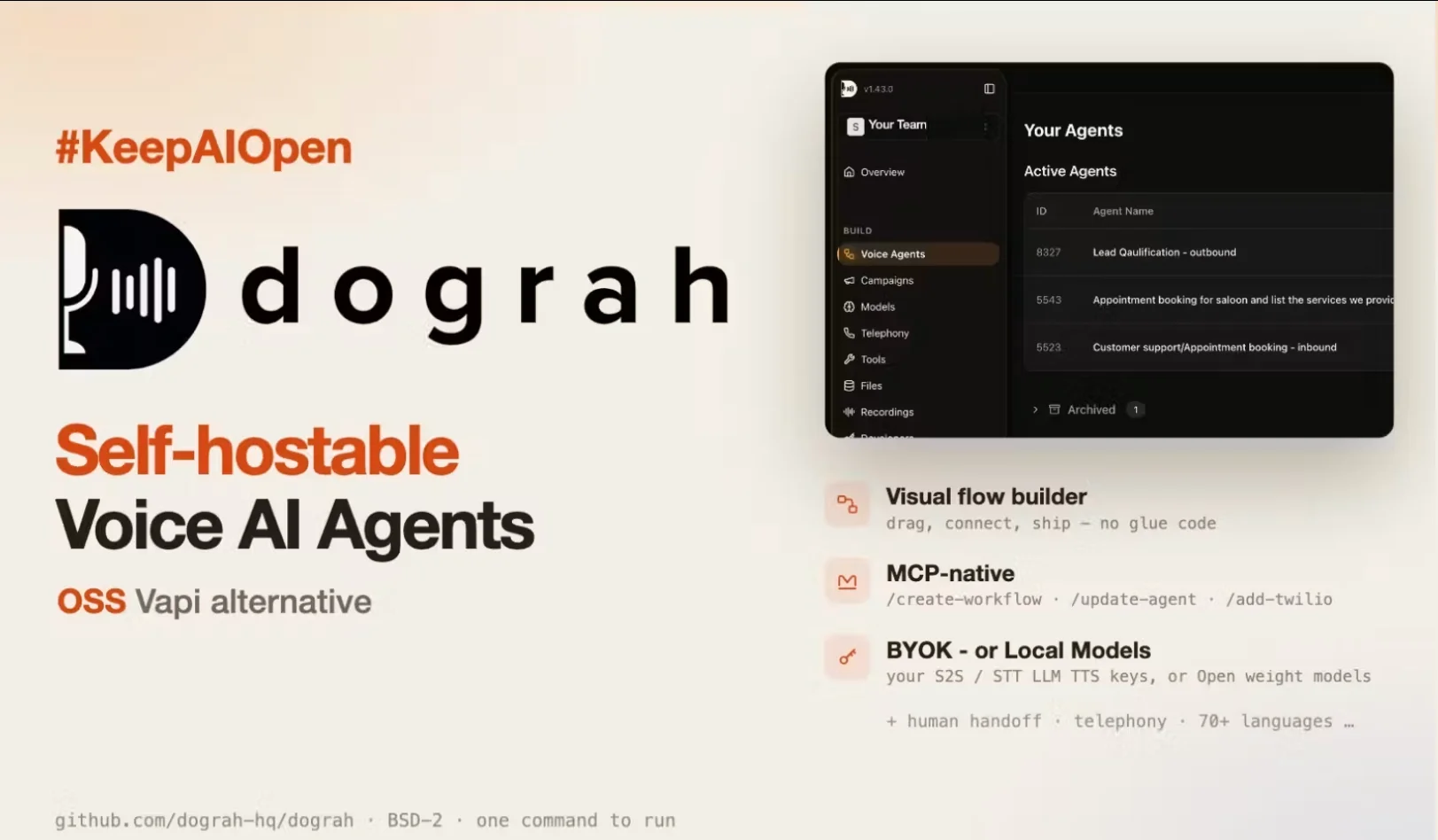
On Product Hunt, Dograh launched with a clear and ambitious claim: “The open source VAPI alternative.” It earned #1 Product of the Day, #1 Product of the Week, and strong placement as a top Developer Tools launch, while the GitHub repository climbed rapidly and drew attention from the NVIDIA Inception Program. The official site reinforces the positioning: a self-hostable voice agent platform and open-source alternative to Vapi and Retell — voice agents you can actually fork.
Closed voice platforms force teams to rent their agents. Dograh takes the opposite approach. Nothing is gated. You get a visual flow builder, the ability to plug in your own model keys across 30+ integrations or run local models, telephony, human transfer, advanced QA and monitoring — all free to self-host with a single command. You can also connect Claude Code or other MCP clients to design and modify voice agents in natural language. Data never has to leave your perimeter.
This review examines Dograh from every practical angle that matters to builders and operators: philosophy and differentiation, architecture and model flexibility, the visual workflow builder, speech-to-speech and hybrid voice modes, deployment options, compliance posture, developer experience (including MCP), pricing, strengths, limitations, and who should adopt it.
The Core Problem and Dograh’s Answer
Building production voice agents has historically meant weeks of plumbing. Teams wire telephony, WebRTC, speech-to-text, LLM reasoning, text-to-speech, call transfer, variable extraction, and observability — then redeploy for every small change. Hosted platforms such as Vapi and Retell remove much of that friction, but they introduce vendor lock-in, per-minute platform fees, and data residency constraints that many regulated industries cannot accept.
Dograh was built by YC alumni and exit founders who experienced this pain directly. The platform ships the full stack as open source (BSD 2-Clause). You can run it yourself forever for free, bring your own keys for every component, or hand operations to Dograh’s managed cloud or private-cloud offering. The same codebase supports laptop prototypes, high-volume production, and fully air-gapped enterprise deployments.
Architecture: Every Box Is Swappable
Dograh treats the voice pipeline as a set of interchangeable modules. You choose:
- Inbound channel (phone, widget, outbound)
- Speech-to-text (Deepgram, AssemblyAI, Speechmatics, Gladia, Whisper, Voxtral, Canary, or others)
- LLM / brain (OpenAI, Gemini, Groq, OpenRouter, Azure, AWS, Hugging Face, xAI, Minimax, Sarvam, local models)
- Text-to-speech (ElevenLabs, Cartesia, Inworld, Rime, Camb.ai, Smallest AI, Kokoro, Chatterbox, custom clones)
- Telephony (Twilio, Telnyx, Plivo, Vonage, Cloudonix, Asterisk, Vobiz)
You can also skip the classic STT → LLM → TTS cascade entirely and run speech-to-speech models such as Gemini 3.1 Flash Live or GPT Realtime. Audio goes in and audio comes out with real turn-taking, interruption handling, and dramatically lower latency — no text round-trip.
This modularity is the practical expression of the open-source promise. Cost, latency, quality, language coverage, and data residency can all be optimized independently without rewriting the agent logic.
Visual Workflow Builder and Production Features
Agents are designed in a drag-and-drop visual flow builder. Nodes cover conversation steps, global instructions, tools, conditional transitions, and end-call outcomes. You can test immediately inside the browser with Test Audio (real voice) or Test Chat (fast prompt iteration). Post-call capabilities include transcripts, recordings, variable extraction, disposition derivation, and QA monitoring.
Human transfer is first-class: the agent can hand the call to a live agent or existing PBX with custom disposition. Observability integrates with tools such as Langfuse. The platform supports multi-tenancy for telephony providers and dynamic call routing.
A distinctive production feature is hybrid voice synthesis. Pre-recorded human voice clips (greetings, confirmations, common phrases) are mixed with live TTS in the same cloned voice. The LLM decides when a pre-recorded line fits and falls back to TTS only when needed. The result is lower latency, more natural sound, and TTS cost reductions reported up to 3×, while conversion rates benefit from the more human feel.
MCP: Build Voice Agents by Writing
Dograh ships a Model Context Protocol server. Point Claude Code, Cursor, OpenClaw, Codex, or any MCP client at it and you can create, modify, and deploy full voice agents without leaving the IDE. Natural-language instructions such as “Build me an AI calling agent for EMI reminders and collections” or “Add a CRM fetch step before the call begins” generate the corresponding workflows, scripts, and wiring. This turns agent development into a collaborative conversation with your coding assistant rather than pure manual graph editing.
Python and TypeScript SDKs further support programmatic control for teams that prefer code-first workflows.
Deployment Options and Data Sovereignty
Three clear paths exist:
- Self-host (open source) — Clone the repo, run docker compose up, and you are live. Forever free, full platform, your servers, your data.
- Managed cloud — Dograh hosts, patches, and scales the same stack. You build and ship agents with zero infrastructure work.
- Private cloud / on-prem — Dograh deploys the entire stack inside your VPC or on-premise environment. Data residency and perimeter controls remain under your existing certifications. They handle orchestration and reliability.
Because the platform can run fully inside your boundary — including local or in-perimeter models — call audio, recordings, transcripts, prompts, and customer PII never need to leave. This is decisive for fintech, healthtech, telemedicine, insurance, banking, legal, pharma, defense, government, and any jurisdiction with strict data-residency rules (EU/GDPR, Switzerland, UK, Saudi Arabia, UAE, Singapore, South Korea, Japan, etc.). Existing HIPAA, GDPR, SOC 2, ISO 27001, or CCPA controls continue to apply without requiring a third-party vendor audit of Dograh itself.
Pricing
- Open Source / Self-host: Free forever. No per-minute platform fees. Bring your own model and telephony keys.
- Managed cloud: Usage-based, starting around 1¢ per minute of platform usage plus model costs (roughly 7¢/min range in public figures, with volume discounts available).
- Enterprise / Private cloud: Custom pricing with volume commitments, SSO/SAML, audit logs, dedicated support, and SLAs.
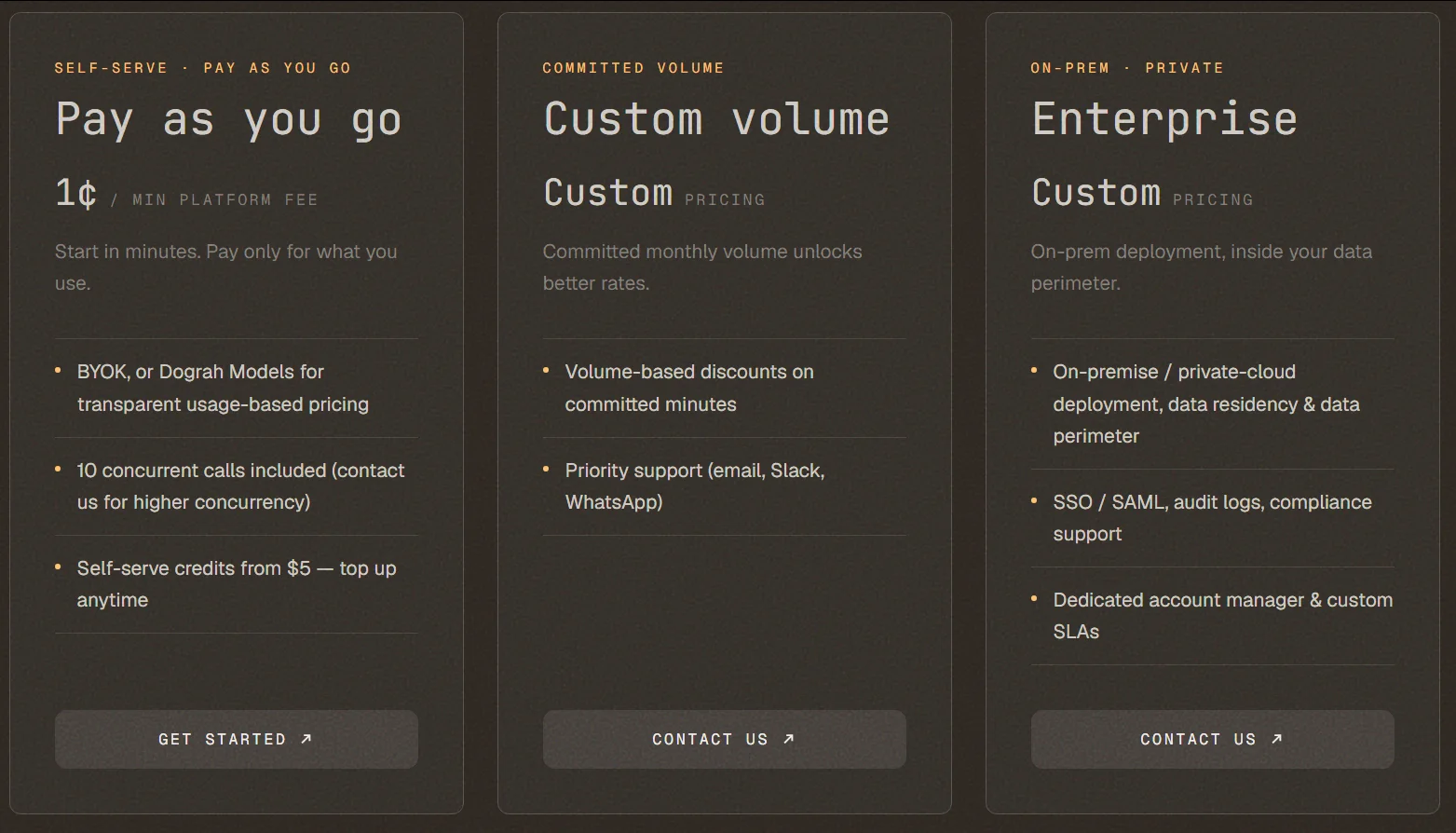
The economic model is deliberately aligned with the open-source philosophy: the platform itself is free when you run it; you pay only when you want Dograh to operate it or when you consume managed model capacity.
Strengths
- True open source (BSD 2-Clause) with no feature gating and full self-host capability.
- Complete control over every pipeline component and the ability to run fully local or air-gapped.
- Visual builder plus MCP-native development that supports both no-code and code-first teams.
- Hybrid pre-recorded + TTS and native speech-to-speech modes that improve latency, cost, and naturalness.
- Strong compliance and data-residency story for regulated industries.
- Rapid time-to-first-agent (under two minutes claimed for basic setup).
- Active development, clear Product Hunt validation, and growing GitHub traction.
- Transparent comparison against proprietary alternatives on the axes that matter most to serious teams.
Limitations and Considerations
Self-hosting requires Docker familiarity and capacity planning for concurrent calls; hardware sizing is largely left to the operator. LLM swapping for fully local stacks is still maturing in some areas. Teams that want a pure SaaS experience with zero operations will prefer the managed cloud, which introduces usage costs. As with any voice platform, real-world performance depends heavily on the quality of the underlying STT, LLM, and TTS providers you choose. Early documentation and community support are solid but still evolving relative to more mature proprietary platforms.
Who Should Use Dograh
Dograh is ideal for:
- Engineering and product teams that need production voice agents without vendor lock-in.
- Regulated industries (fintech, healthcare, insurance, government, defense) that require data residency and auditability.
- Startups and scale-ups that want to start free on their own infrastructure and later move to managed or private-cloud operations.
- Developers who already work with Claude Code, Cursor, or other MCP clients and want to generate voice agents conversationally.
- Anyone evaluating Vapi or Retell who prioritizes ownership, cost control, and the ability to fork the entire stack.
It is less necessary for pure experimentation where a simple hosted sandbox is sufficient and data residency is irrelevant.
The Product Hunt Verdict
Dograh represents the natural next step in the voice-agent category: the open-source, self-hostable infrastructure layer that follows the same trajectory chat agents experienced earlier. By making every component swappable, supporting both cascade and speech-to-speech pipelines, adding hybrid human+TTS voice, and exposing the whole system through MCP, the team has built something that feels production-ready rather than merely demoware.
For Product Hunt makers and technical teams, the practical test is straightforward. Spin up the Docker stack, build a simple agent in the visual editor (or ask Claude Code to do it via MCP), connect a telephony provider or test in-browser, and measure latency, cost, and control against the proprietary alternatives. The combination of zero lock-in, full data sovereignty, and modern developer ergonomics is rare in this space.
Dograh will not eliminate the need for careful prompt engineering, telephony configuration, or load testing. It will, however, remove the weeks of infrastructure plumbing and the long-term risk of renting your agents from a closed platform. That is a meaningful contribution, and the early Product Hunt and GitHub reception suggest the community recognizes it.