On Product Hunt, AdAnt AI launched with a sharp, memorable tagline: “Claude for viral, high-converting social ads.” It quickly claimed #1 Product of the Day, #1 of the Week, and #1 of the Month honors. The product is not another generic AI video generator. It is positioned as a team of Creative Agents that handle social ad strategy, creation, and iteration — built on the exact playbooks its founding team used to generate more than 50 million organic views and reduce paid acquisition costs by an average of 60%.
The official site frames AdAnt as “ChatGPT for Viral, Converting Social Videos.” You talk to an Ad Creative Agent. You share a product URL or an inspiration video. The system researches what is actually working on TikTok, Instagram Reels, and YouTube Shorts for your audience, recommends hooks and formats, and produces batches of editable 9:16 ad variants ready for testing. Everything lives in one conversational workspace instead of a scattered collection of research tabs, scripting docs, and editing tools.
This review examines AdAnt AI from every practical angle: the problem it solves, how the agentic workflow actually operates, core capabilities, research and strategy depth, output quality and iteration speed, pricing and packaging, strengths, limitations, and who will get the most value from it.
The Problem AdAnt Is Solving
Short-form social advertising has become both essential and exhausting. Winning creative requires constant research into what is currently performing, translation of those patterns into brand-relevant concepts, production of enough variants for meaningful testing, and rapid iteration based on results. Traditional agency retainers for this work often run $2,500–$7,500+ per month and still deliver only a handful of concepts every few weeks. Internal teams face the same bottleneck: research is slow, creative direction is inconsistent, and production capacity is limited.
AdAnt collapses that loop into a chat-driven agent. The founding team’s obsession with one question — “How do you make people stop scrolling?” — produced a repeatable system. They turned the research methods, creative frameworks, and iteration habits behind their own results into software. The result is an AI creative team that starts from real platform data rather than generic “viral” templates.
How AdAnt Works
The workflow is intentionally conversational and agentic:
- Start with a product URL or inspiration video. Paste your website or a reference ad. AdAnt identifies audience, offer, and strongest product angles, or it deconstructs the reference video’s scenes, pacing, hooks, captions, and visual beats.
- Discuss creative direction. In the same chat you can refine strategy, request specific goals (acquisition, education, social proof, retention), reference brand assets, or ask for particular avatar styles and tones.
- Generate batches of variants. The system produces multiple 9:16 concepts with different hooks, CTAs, avatars, and angles. These are designed for testing rather than as single polished hero videos.
- Iterate inside one workspace. Reference previous products, avatars, or winning structures by name. Swap hooks or calls-to-action without rebuilding the entire video from scratch. Manage reusable assets and brand profiles that persist across sessions.
The experience is closer to briefing a skilled creative team than operating a traditional video tool. An infinite canvas and asset library support visual organization, while the agent maintains context so you do not re-explain your brand every time.
Core Capabilities
Real-time social content research
AdAnt continuously analyzes TikTok, Instagram, and YouTube for formats and hooks that are still rising for specific audiences. It distinguishes emerging patterns from saturated trends. This is not a static library of “best practices.” The research agent focuses on what is currently working for your ideal customer profile.
Strategy agent by marketing goal
You can request distinct creative strategies for acquisition, education, social proof, retention, or other objectives. Strategies can be refined with natural-language feedback or additional reference videos. Time windows for analysis are adjustable (broader historical windows for initial strategy, tighter recent windows for ongoing weekly planning).
URL-to-ad and reference-to-ad generation
From a product page or an existing high-performing video, AdAnt maps structure and messaging onto your brand and renders multiple ad concepts complete with AI avatars. More than 100 AI avatars are available, and outputs are watermark-free on paid plans.
Batch variation and testing orientation
The system is built for volume. Claims on the site and in early coverage point to first batches in roughly 30 minutes and 20–50 variants per round — versus the typical agency pace of a few concepts over weeks. The same proven structure can be reused across new hooks, avatars, and product angles.
Persistent brand and product profiles
Save positioning, audience definitions, visual guidelines, and assets under reusable Product profiles. Reference them with simple mentions so the agent stays on-brand without repeated prompting.
Upcoming ecosystem extensions
Free AdAnt plugins for Codex and Claude are planned, bringing deeper research and content-strategy capabilities directly into the tools many teams already use.
Pricing and Packaging
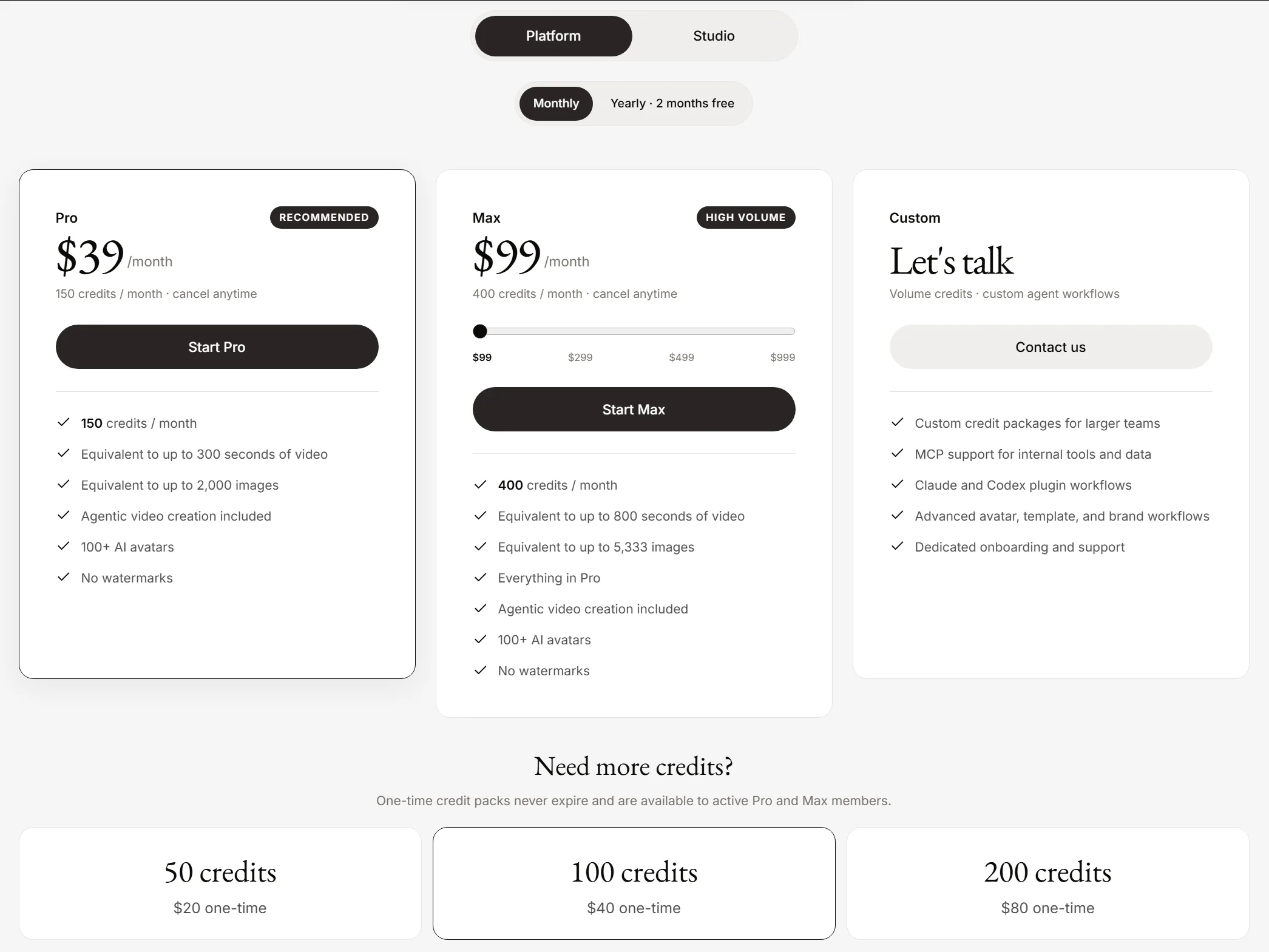
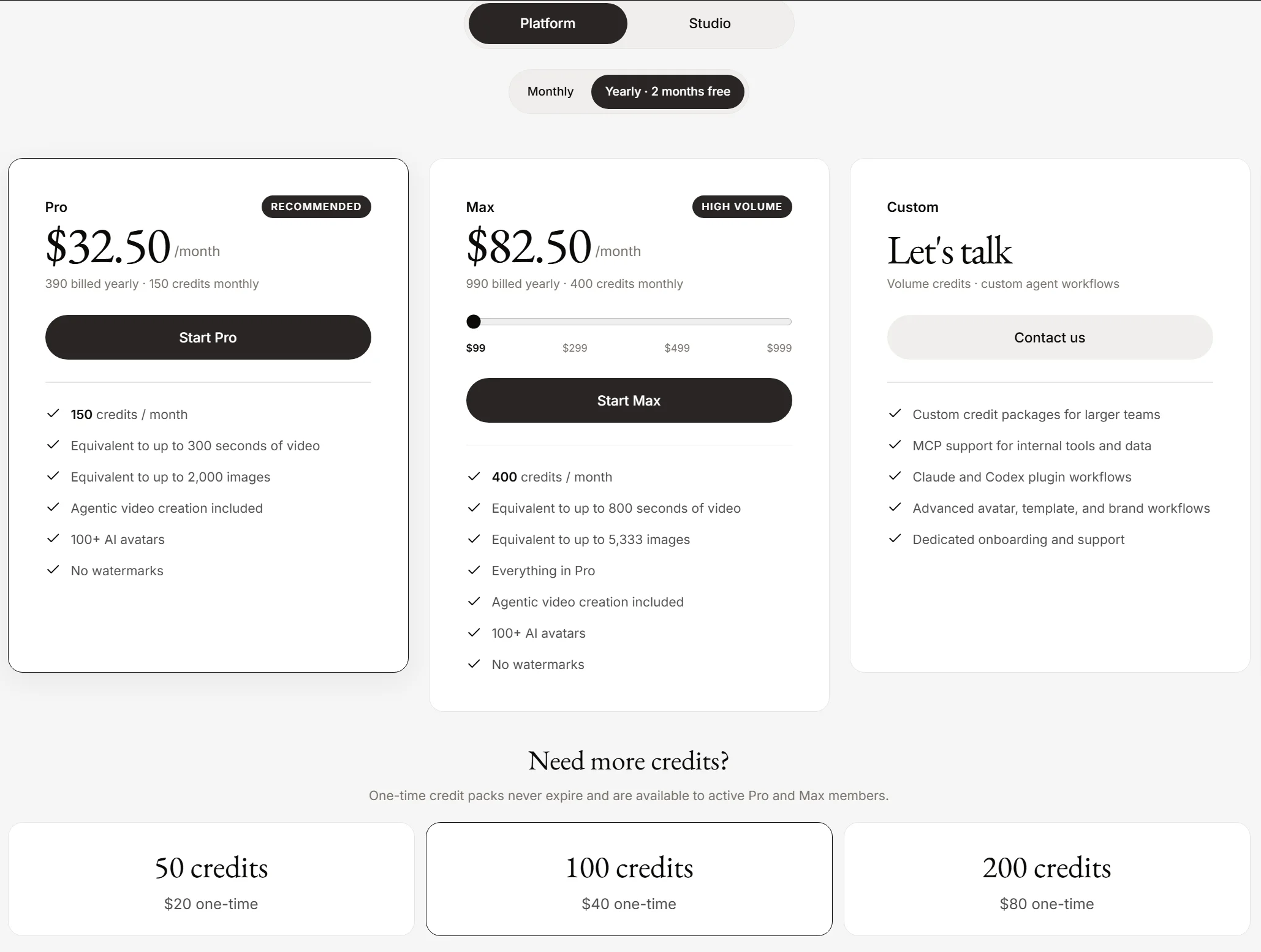
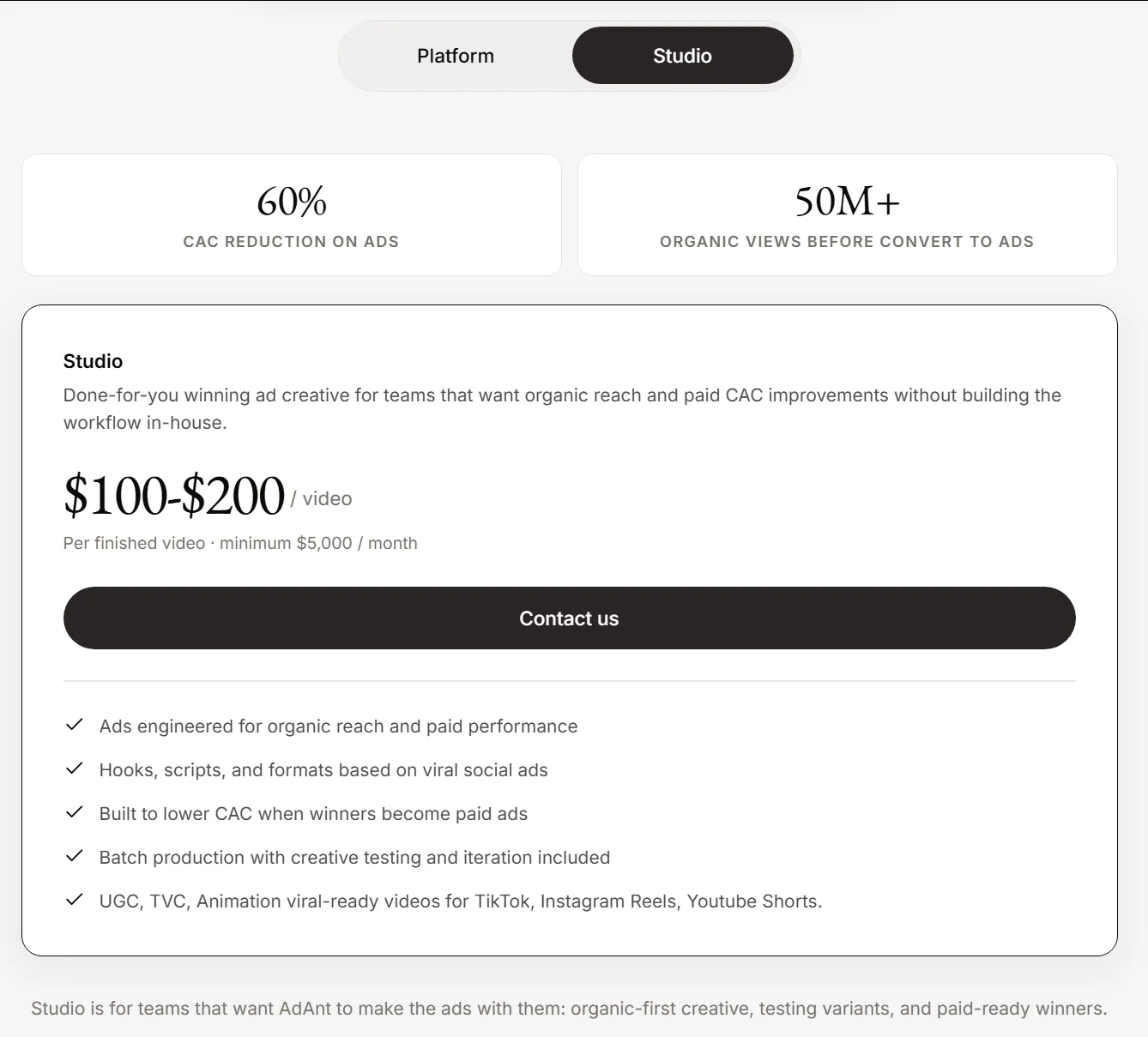
AdAnt uses a hybrid model. The core self-serve Pro plan is priced accessibly (reported around $32.50–$39 per month depending on billing period), typically including substantial monthly credits (enough for meaningful video and image volume), access to 100+ AI avatars, agentic creation, and no watermarks. New users often receive starter credits to complete a first video. A higher-touch Studio / done-for-you option exists at $100–200 per finished video (with monthly minimums) that includes human UGC creators and end-to-end handling for teams that want the retainer experience without managing an agency.
Pay-as-you-go credits and custom packages for larger teams are available. The economics are deliberately positioned against traditional creative retainers: the subscription cost is a fraction of a monthly agency fee while delivering far higher testing volume.
Strengths
- Research-first approach grounded in live platform data rather than generic templates.
- True agentic workflow that moves from strategy to production inside one conversational interface.
- Strong orientation toward testing volume (many variants quickly) instead of single perfect videos.
- Persistent brand memory and reusable structures that reduce repetitive work.
- Clear product-market fit for performance marketers, growth teams, and agencies that need continuous creative throughput.
- Transparent founding story and measurable claims (50M+ organic views, ~60% CAC reduction) that give credibility.
- Competitive pricing relative to agency alternatives, with a clear path from self-serve to higher-touch service.
Limitations and Considerations
AdAnt is optimized for short-form vertical social ads. Teams needing long-form, highly cinematic, or complex multi-scene narrative work will still require traditional production. Fine-grained post-generation control over individual scenes, captions, and brand elements is an area early users have requested deeper precision. Output quality depends on the clarity of the product URL or reference material and the quality of the conversation with the agent. As with any AI video system, some results will need human polish before paid media spend. The product is still early; feature depth and integration breadth will continue to evolve.
Who Should Use AdAnt AI
AdAnt is strongest for growth and performance marketing teams, e-commerce brands, and agencies that run continuous paid social tests on TikTok, Instagram, and YouTube. It is particularly valuable when the bottleneck is creative volume and research rather than final pixel-perfect production. Solo founders and small teams who previously could not justify agency retainers now have a practical way to generate testable ad batches at scale. Larger organizations can use the self-serve layer for rapid ideation and the Studio tier when they want human-augmented delivery.
It is less ideal for pure brand storytelling projects that prioritize craft over testing velocity, or for teams whose primary channels are not short-form vertical video.
The Product Hunt Verdict
AdAnt AI succeeds by treating social ad creation as a research-and-iteration problem rather than a pure generation problem. The combination of live platform analysis, goal-specific strategy, conversational direction, and high-volume variant output addresses the exact pain that makes short-form advertising expensive and slow. The founding team’s own results give the product an authenticity that many AI creative tools lack.
For Product Hunt makers and growth operators, the practical test is simple: paste a product URL, ask for a strategy and a first batch of variants, and measure how quickly you move from idea to testable creative. In a category crowded with tools that generate videos, AdAnt stands out by trying to generate the right videos — and enough of them to learn what actually converts.
It will not replace skilled creative directors or high-end production. It will, however, dramatically compress the research-to-test loop for the majority of performance-driven social advertising. That is a focused and valuable contribution, and the early Product Hunt reception suggests the market agrees.