On Product Hunt, PaymentKit launched with a sharp and practical claim: “Billing that survives a processor shutdown.” It earned strong early traction, including #1 Product of the Day and #2 Product of the Week recognition, and sits at a 4.5 rating. The official site frames the value more broadly: “The billing platform that gives you freedom.”
PaymentKit is a multi-processor billing and payment orchestration platform built for SaaS, e-commerce, and a range of higher-risk or specialized verticals. It does not replace Stripe, Adyen, Authorize.net, or other processors. Instead it sits above them: routing every transaction to the processor most likely to approve it, cascading soft declines automatically, vaulting cards and wallet credentials independently as network tokens under the merchant’s control, and running the full subscription lifecycle so renewals continue even if a merchant ID (MID) is shut down overnight.
The core insight is simple and hard-won. For subscription businesses, a single processor is a single point of failure. MID shutdowns are a when, not an if. When that happens, most platforms force customers to re-enter cards — the primary cause of migration churn. PaymentKit’s independent vaulting and orchestration layer is designed so subscribers never feel the switch.
This review examines PaymentKit from every practical angle: the problem it solves, payment orchestration and cascading, independent token vaulting, subscription billing features, dunning and recovery, revenue metrics, supported industries, no-code vs API paths, pricing, strengths, limitations, and who should adopt it.
The Problem PaymentKit Targets
Subscription and recurring-revenue businesses typically assemble their stack from separate tools: one system for billing logic, another for payment processing, and a third for revenue analytics. That fragmentation creates three persistent risks:
- Processor concentration — All volume flows through one MID. A risk decision, policy change, or outage can stop revenue cold.
- Token lock-in — Cards and wallets are vaulted inside the processor. Switching or adding a backup processor requires customers to re-enter payment details, driving involuntary churn.
- Soft-decline leakage — A temporary decline on one processor is treated as a lost sale instead of being tried on another that might approve it.
PaymentKit was born from a parent company that runs a portfolio of subscription brands and repeatedly hit exactly these problems. The platform unifies billing, orchestration, and revenue visibility so that a dollar’s lifecycle — from signup through renewal, recovery, and bank settlement — is managed in one place while remaining processor-agnostic.
Payment Orchestration and Cascading
At the heart of PaymentKit is a routing engine that treats processors as interchangeable rails rather than permanent homes for customer data.
- Transactions can be routed by geography, card brand, payment method, currency, transaction value, or custom rules.
- Soft declines cascade automatically to a second (or subsequent) processor instead of becoming lost revenue.
- Automatic failover keeps checkout alive if a gateway goes down or latency spikes.
- Merchants keep the processors they already use (Stripe, Adyen, Authorize.net, Paysafe, Airwallex, Checkout.com, and others) and manage them through a single layer.
Public case claims include average authorization-rate lifts of 10%+ after switching, with one cited example moving from 63% to 76% through intelligent routing and cascading. These numbers will vary by vertical, card mix, and existing processor performance, but the architectural direction is clear: reduce single points of failure and recover soft declines that traditional single-processor setups simply abandon.
Independent Vaulting and Data Sovereignty
This is the feature the team emphasizes most. Cards, Apple Pay, and Google Pay credentials are vaulted as network tokens under the merchant’s control, not locked inside any single processor. Consequences:
- Adding or dropping a processor becomes a routing change, not a customer-facing migration.
- If a MID is shut down, the next renewal simply lands on a healthy account. Subscribers do not re-enter cards.
- True portability of the customer payment relationship — the primary source of migration churn is removed.
Wallet tokenization is supported out of the box so Apple Pay and Google Pay can be offered while still keeping credentials in the independent vault. For businesses that have lived through (or fear) sudden processor terminations, this is the practical definition of “billing that survives a processor shutdown.”
Full Subscription Billing Lifecycle
PaymentKit is not only an orchestration layer; it runs the billing engine itself:
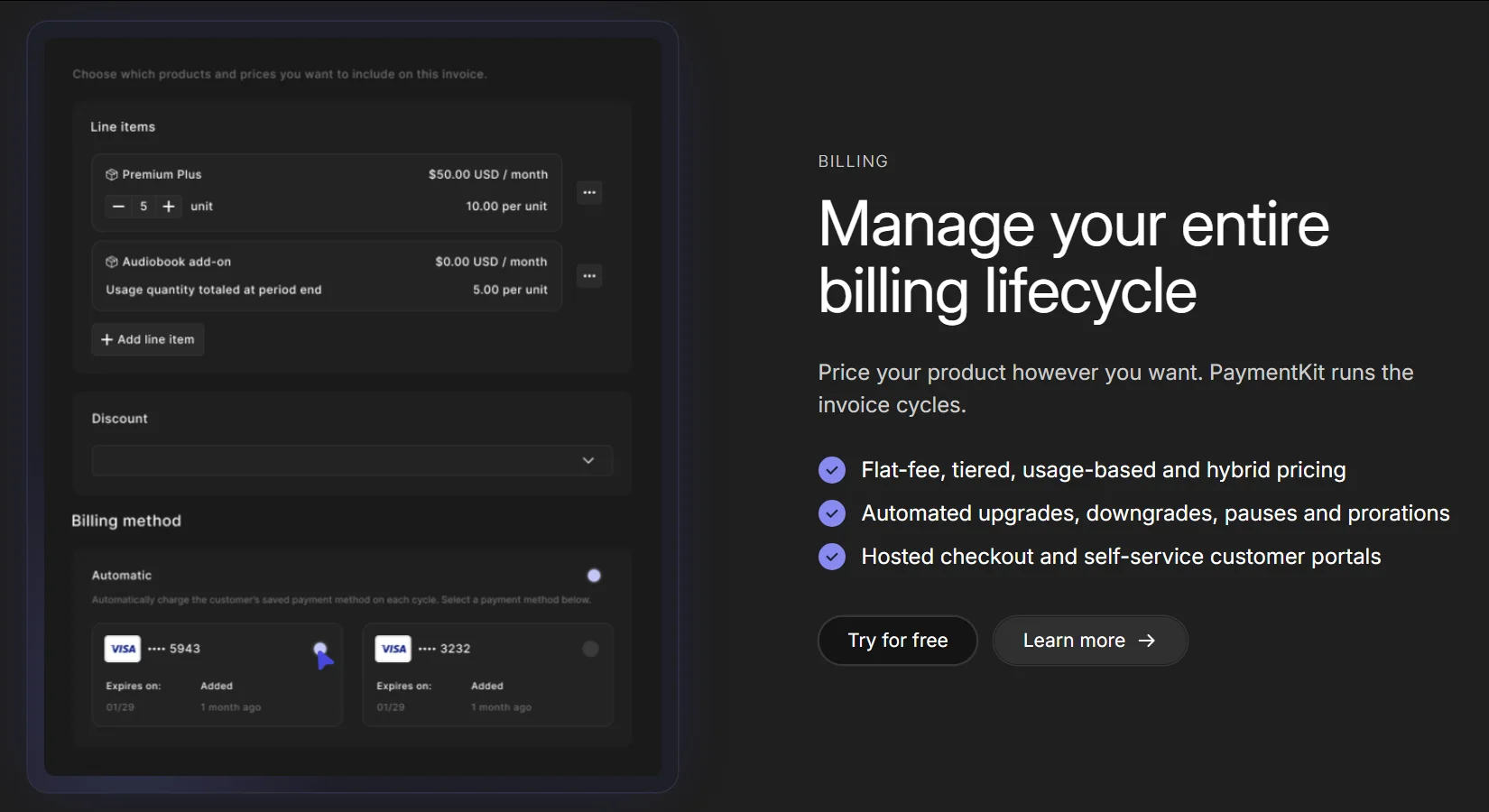
- Flat-fee, tiered, usage-based, and hybrid pricing models
- Automated upgrades, downgrades, pauses, and prorations
- Trials, discounts, and metered billing
- Hosted checkout and self-service customer portals
- Global and digital currency support
Teams can launch without writing code, or integrate via clean APIs, SDKs, and a sandbox when they need custom flows. The same system of record handles invoices, webhooks, and the customer lifecycle, reducing the classic problem of billing data living in one tool while payment and revenue data live in others.
Dunning and Failed-Payment Recovery
When a renewal fails, PaymentKit runs a full recovery sequence:
- Adaptive retries timed by decline code and billing cycle (the failures that often fix themselves)
- Brand-matched dunning emails with a self-serve card-update portal
- Cross-processor recovery where appropriate
The platform cites an average 12.4% lift in failed-payment recovery. Combined with higher initial authorization rates, the compound effect on retained revenue can be material for businesses with meaningful involuntary churn.
Revenue Metrics and Visibility
A single consolidated dashboard sits across every connected processor. Merchants can:
- Compare success rates and costs by processor
- Monitor MRR, churn, ARPU, LTV and related metrics in one place
- Surface cancellations and involuntary declines early
- Export for external reporting
The goal is one source of truth instead of stitching exports from billing, gateway, and analytics tools that frequently disagree.
Industries and Risk Profiles
PaymentKit explicitly supports both mainstream and more complex verticals:
- Ecommerce and subscriptions
- AI and SaaS (including usage-based and hybrid models)
- Telehealth and online pharmacy
- Peptides and wellness
- Adult and dating
- Gaming and digital products
- Broader high-risk categories
The combination of processor-agnostic billing, independent token vaulting, and multi-MID routing is particularly relevant for categories where underwriting is stricter and single-processor concentration is riskier.
No-Code and Developer Paths
- No-code: Launch subscriptions, invoices, checkout, and customer portals without writing code.
- Yes-code: Integrate in under an hour with APIs, SDKs, and a robust sandbox for custom experiences.
This dual path lets early-stage teams move quickly while still supporting engineering teams that need deeper control.
Pricing
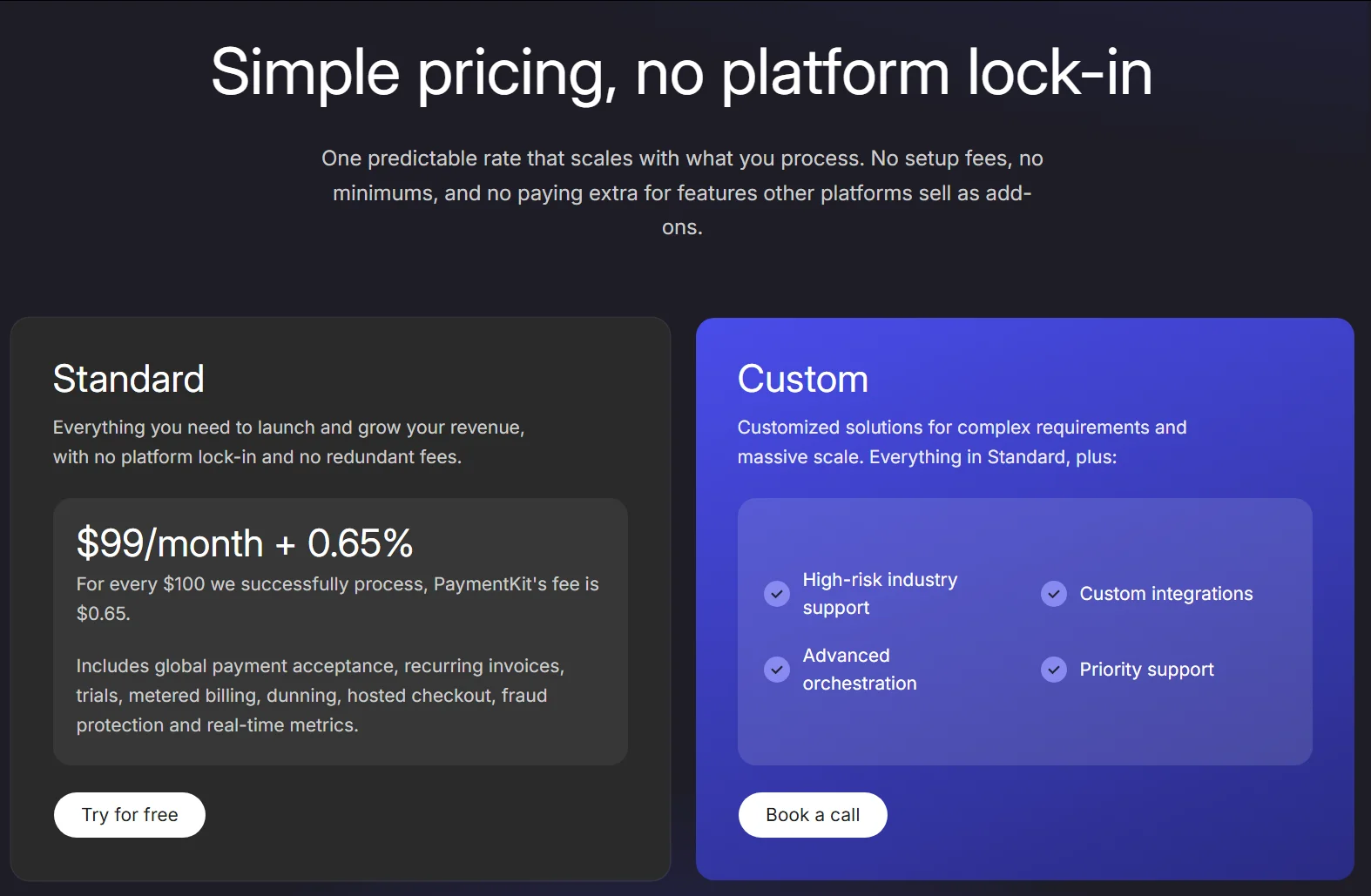
Standard plan: $99/month + 0.65% of successfully processed volume.
No setup fees, no minimums. The percentage is charged only on successful processing. The plan includes global acceptance, recurring invoices, trials, metered billing, dunning, hosted checkout, fraud protection, and real-time metrics.
Custom plans are available for high-risk support, advanced orchestration, custom integrations, and priority support.
The model is deliberately simple: one predictable platform fee plus a usage component, without charging again for features that many competitors treat as add-ons.
Strengths
- True multi-processor orchestration with cascading on soft declines
- Independent network-token vaulting that survives MID shutdowns and enables processor portability
- Unified billing + payments + revenue metrics in one system of record
- Flexible pricing models (flat, tiered, usage, hybrid) with full lifecycle automation
- Practical dunning and recovery that measurably lifts retained revenue
- Support for both mainstream SaaS/ecommerce and higher-risk verticals
- No-code launch path plus clean API/SDK option
- Transparent, relatively simple pricing
- Strong Product Hunt reception and concrete authorization/recovery lift claims from early users
Limitations and Considerations
PaymentKit is still relatively new as a commercial platform (2026 launch window). Long-term reliability at very large scale, breadth of processor coverage in every geography, and the maturity of advanced enterprise features will continue to be proven. The 0.65% fee is additive to underlying processor costs, so total cost of ownership must be modeled against expected authorization and recovery lifts. Businesses that are happy with a single low-risk processor and have no migration or concentration concerns may find less incremental value. As with any orchestration layer, correct configuration of routing rules and decline handling is required to realize the claimed benefits. High-risk verticals should still expect underwriting and compliance work; PaymentKit provides infrastructure, not a free pass on risk.
Who Should Use PaymentKit
PaymentKit is strongest for:
- SaaS and subscription businesses that want to reduce single-processor risk
- Companies that have experienced (or fear) MID shutdowns and the resulting card re-collection churn
- Teams running or planning multi-processor strategies for higher authorization rates
- AI, usage-based, and hybrid pricing models that need flexible billing logic
- Verticals with stricter underwriting where processor diversification is operationally important
- Founders and operators who want billing, payments, and revenue data in one place without building the orchestration layer themselves
It is less critical for simple one-time payment businesses, pure marketplaces that already have sophisticated in-house orchestration, or teams fully satisfied with a single stable, low-risk processor and no plans to diversify.
The Product Hunt Verdict
PaymentKit stands out in the crowded billing and payments category by treating processor failure as a design constraint rather than an edge case. Independent token vaulting, intelligent routing, automatic cascading, and unified subscription management form a coherent answer to the question every recurring-revenue business eventually faces: what happens when the processor says no?
For Product Hunt makers and operators of subscription products, the practical evaluation is straightforward. Connect the processors already in use, run volume through the routing and cascading logic, measure authorization and recovery rates against the previous baseline, and test a simulated processor switch to confirm that subscribers continue billing without re-entering cards. If the lifts and the operational resilience materialize, PaymentKit delivers on its central promise.
Billing that survives a processor shutdown is not a marketing slogan for the businesses that have lived through one. PaymentKit is one of the clearer attempts to turn that resilience into standard infrastructure.