On Product Hunt, Hey Noah launched as “a proactive AI executive assistant for founders” and quickly claimed the #1 Product of the Day and #1 of the Week titles. The tagline cuts through the usual AI assistant noise: “Claude talks to you; Noah talks to your network.” It positions itself less like another chatbot or scheduling tool and more like Tesla Full Self-Driving for executive logistics — autonomous rather than assistive, living inside the channels founders already use every day.
The official site frames Noah as Executive Admin + Chief of Staff + Coach. It is a secure, autonomous AI assistant available through voice and SMS that has its own identity, works across your network, and proactively helps you lead. Unlike copilots that wait for prompts inside a dashboard, Noah operates in SMS, WhatsApp, email, and Slack. You text it the way you would text a human executive assistant, and it handles the back-and-forth with other people so nothing slips.
This review examines Hey Noah from every angle that matters to founders, operators, and busy executives: core philosophy and differentiation, how the product actually works, key capabilities, integrations, real-world workflows, pricing and accessibility, privacy and reliability, strengths, limitations, and who it is best suited for.
The Core Philosophy: Autonomy Over Assistance
Most AI productivity tools still require the user to be the operator. You open an app, craft a prompt, review drafts, copy-paste, and chase responses yourself. Noah inverts that model. The founder, Ashish Toshniwal, spent 14 years building a company that reached $100M in revenue with dozens of Fortune 500 clients. He had a real executive assistant who managed not just the calendar but the relationships. The playbook from that experience is what the team encoded into Noah.
The product is deliberately narrow and deep. It focuses on time and relationships — the two levers that high-performing executives actually manage — rather than trying to be a general-purpose agent for every task. Noah schedules meetings, negotiates times, sends emails and follow-ups, prepares context, captures notes and action items, and surfaces relationship insights. It does these things by communicating outward on your behalf rather than merely suggesting what you should do next.
The analogy the team uses is deliberate: cruise control keeps you in the lane; Full Self-Driving takes you to the destination. Noah aims for the latter in the domain of executive logistics.
How You Actually Use Noah
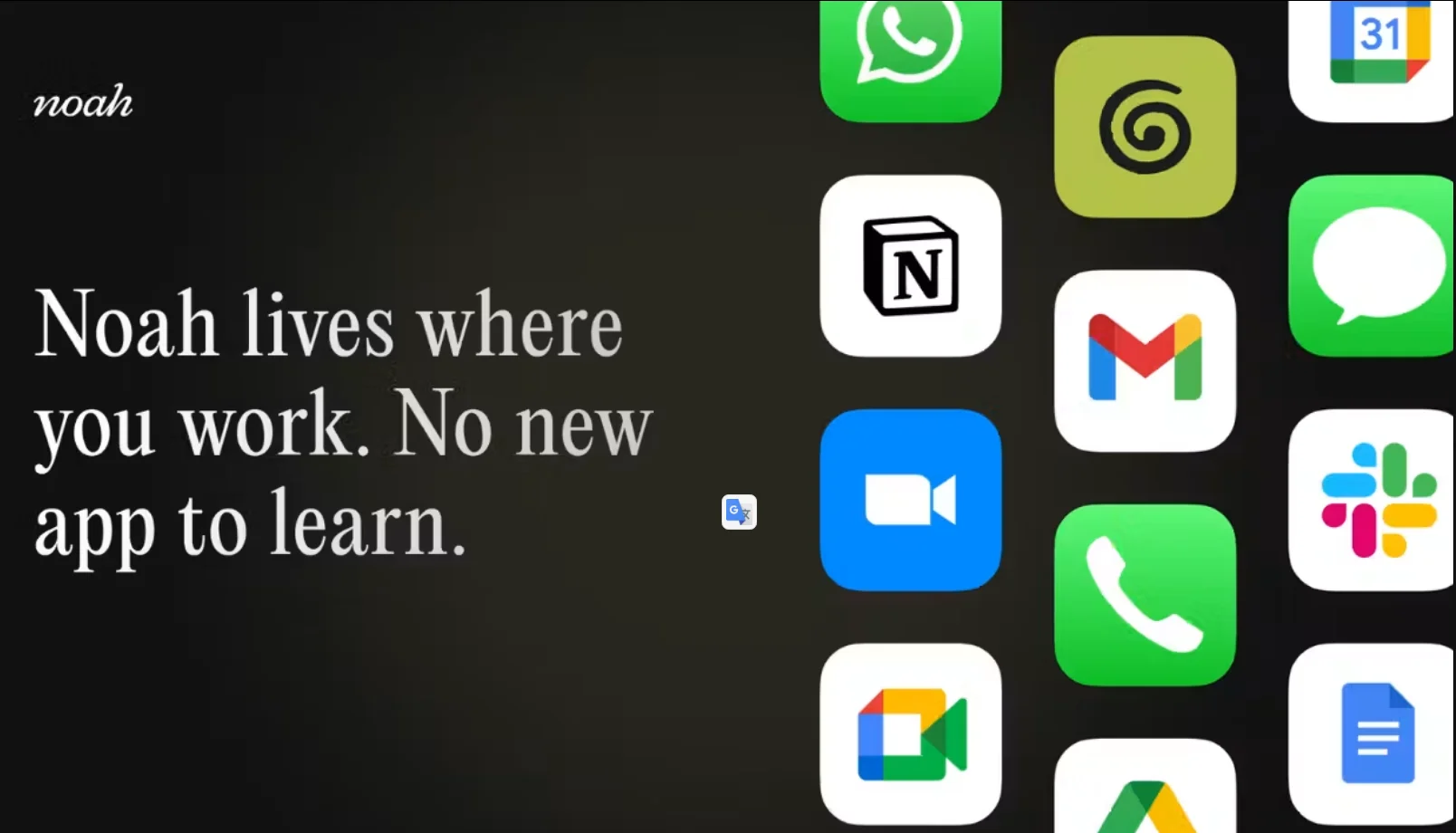
There is no new app to install and no dashboard to learn. Interaction happens inside the channels you already live in:
- Text Noah via SMS or WhatsApp.
- CC Noah on an email thread.
- Message it in Slack.
- Send voice memos, images, or attachments when helpful.
Examples of natural commands include:
- “Set up coffee with Sarah next week.”
- “I’m out Thursday and Friday — handle everything.”
- “Stuck in traffic, going to be 20 minutes late.”
- “Prep me for my 2pm with Acme.”
- “Reschedule my call with Luke to next week.”
- “What’s on my schedule tomorrow?”
- “Send me all the action items from today.”
Noah checks calendars, reaches out to the other parties on their preferred channels, negotiates availability, sends calendar invites (with Zoom or Google Meet links), updates attendees when plans change, and confirms when the loop is closed. For restaurant or doctor bookings it can place a real phone call. After meetings it can capture notes and next actions (especially when connected to tools like Granola). Before important conversations it can surface relevant prior context, shared documents, and talking points.
Setup is intentionally short. Connect your calendar and relevant accounts, answer a few preference questions, and Noah begins learning your meeting patterns, protected time, favorite locations, and communication style. Over time it requires fewer clarifications.
Key Capabilities in Practice
Scheduling and logistics
Noah treats availability as more than empty slots. It weighs priorities, buffers, focus blocks, and time zones. Multi-person scheduling is a standout: it reaches each attendee on the appropriate channel and continues negotiating until everyone confirms. Reschedules and cancellations are handled with polite, personalized notes. One text from you can cascade into calendar updates, attendee notifications, and rebooking.
Communication on your behalf
Noah does not just draft emails for you to send. It sends from its own address (with you CC’d for transparency), follows up on stalled threads, and closes the loop. This is the clearest differentiator from most AI writing tools.
Relationship intelligence
Noah monitors interaction patterns and can nudge you when a key relationship is going cold. It maintains context so you can walk into a meeting with a Fortune 500 contact or a junior team member and feel prepared. As Chief of Staff it surfaces opportunities and helps you recognize and retain top performers. As Coach it supports navigation of difficult conversations and more effective leadership behaviors.
Pre- and post-meeting support
Before a meeting Noah can pull prior notes, shared documents, and deal status. Afterward it captures action items and can push summaries or follow-ups to the right Slack channels or task lists while respecting privacy boundaries on sensitive conversations.
Proactive behavior
Noah is designed to surface what matters before you ask — scheduling conflicts, overdue follow-ups, or relationships that need attention — rather than waiting for explicit commands.
Integrations and Ecosystem
Noah connects to the tools founders already use: Google Calendar (read/write), Gmail, Zoom, Slack, HubSpot, Google Docs and Drive, Notion, Google Tasks, and Granola for meeting notes. More integrations continue to be added. The product is intentionally lightweight on the user interface side so that the value lives in the outcomes rather than another place to check.
Pricing and Accessibility
For the first cohort of early adopters, Noah is priced at $49 per month with full functionality, no long-term contracts, and the ability to cancel anytime. A free trial period (commonly referenced as one month or a short trial with no credit card) lowers the barrier to testing. Pricing may evolve as the product matures and expands beyond the founding cohort. Given the time savings on high-value executive work, the economics are easy to justify for founders who currently lose 1–2 hours daily to coordination.
Privacy, Security, and Reliability
Noah is given deliberately scoped access: your primary calendar, emails you explicitly CC it on, and relevant contacts. It does not have open access to your full inbox, files, or photos. Data in transit is encrypted; the company states it does not sell or share data with third parties. For complex or high-stakes multi-party communications, a human-in-the-loop review can occur before messages go out, while routine scheduling and updates run autonomously. Users retain control and can review actions.
Reliability has been a central engineering focus. The team has spoken publicly about pausing growth to rebuild guardrails, evals, confidence scoring, and failure-catching infrastructure after early assumptions about pure model capability proved insufficient. The goal is an assistant reliable enough that you can put it on a real scheduling thread and stop thinking about it.
Strengths
- True outward communication: Noah talks to your network rather than only talking to you.
- SMS-first and channel-native design eliminates the friction of new apps and dashboards.
- Strong focus on the highest-leverage executive work — time and relationships.
- Proactive rather than purely reactive behavior.
- Rapid learning of personal preferences and patterns.
- Transparent communication (you stay CC’d) and scoped data access.
- Clear Product Hunt validation (#1 of the day and week) and founder experience that maps directly to the problem.
Limitations and Considerations
Noah is specialized. It is not a general research agent, coding assistant, or full knowledge-management system. Its scope is calendar, communication, and relationship management. Users with highly complex multi-calendar corporate environments or strict enterprise IT policies will want to evaluate integration depth and compliance carefully. Because it acts on your behalf, trust and monitoring matter; early users should start with lower-stakes threads while building confidence. As with any early-stage autonomous system, edge cases around ambiguous instructions, cultural communication nuances, or unusual calendar constraints can still surface. Mobile experience is strong via SMS/WhatsApp, but power users who prefer visual overviews may occasionally miss a traditional dashboard.
Who Should Use Hey Noah
Hey Noah is built for founders, executives, and high-output operators who run relationship-heavy calendars — sales, business development, fundraising, consulting, or leadership roles with 10+ external meetings per week. It is especially valuable for people who currently lack a dedicated executive assistant or whose fractional support requires as much management as it provides. Solopreneurs and owner-operators (real estate, professional services, family businesses) who sit just below the threshold of hiring a full-time EA will also find it compelling.
It is less necessary for individual contributors with light external coordination needs or teams that already have robust human EA support and mature internal processes.
The Product Hunt Verdict
Hey Noah stands out in a crowded field of AI assistants by refusing to be another prompt-driven copilot. It is an autonomous executive assistant that lives in SMS and actually coordinates with the outside world. The product is opinionated, narrow in scope, and ambitious in autonomy. For founders who feel their days leaking away to logistics and follow-ups, the value proposition is immediate and concrete: text Noah the way you would text a trusted human EA, and let it close the loop.
The early Product Hunt success, the founder’s hard-won operational experience, and the deliberate engineering focus on reliability all point to a product that is solving a real, high-frequency pain rather than chasing demos. It will not replace strategic thinking or deep work. It will, however, remove a large class of coordination tax so that thinking and work can happen.
If you are a founder or executive whose calendar and relationships are both assets and sources of constant friction, Hey Noah is one of the more interesting bets in the current AI assistant landscape. Text it once with a real scheduling request. The difference between a tool that drafts and a system that delivers becomes clear very quickly.