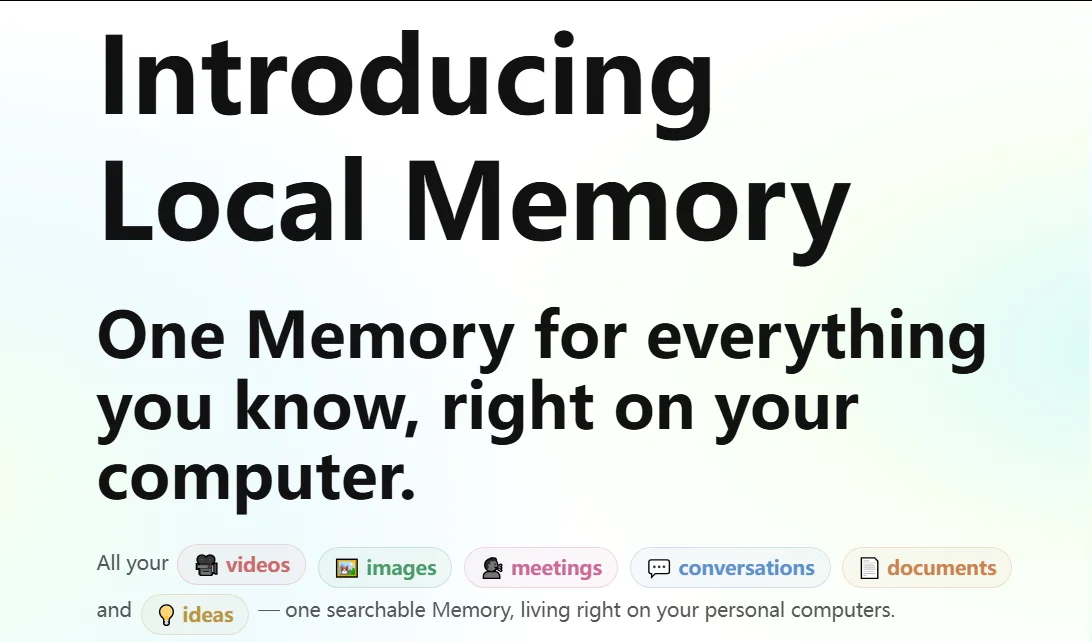
On Product Hunt, Clipto has already proven itself as more than another transcription or search tool. The company previously hit #1 Product of the Day with its core Mac app, and the recent Clipto MCP launch extends that foundation into something far more ambitious: a private, on-device memory layer that AI agents can actually query. The tagline on Product Hunt is simple and powerful — “Fully local, natural language search over terabytes of media.” The official site frames it even more clearly: one Memory for everything you know, living right on your computer.
Clipto is not trying to replace your NLE or become another cloud AI chat wrapper. It solves a quieter, more painful problem that creators, researchers, product teams, journalists, students, and analysts all face: the mountain of video, audio, meetings, screenshots, documents, and voice notes that sits on local drives, never to be usefully recalled. Filenames are useless. Folders become graveyards. Cloud upload is often a non-starter for privacy, cost, or sheer volume. Clipto indexes that data locally with multimodal AI, builds structured memory around people, dialogue, scenes, objects, and events, and then makes the entire corpus searchable in natural language — both inside its own app and, critically, from Claude, ChatGPT, Cursor, and any other MCP-compatible agent.
This review examines Clipto from every practical angle: core technology and local-first architecture, the MCP agent layer, real-world use cases across professions, performance and hardware requirements, integrations, privacy model, strengths, limitations, and who should actually adopt it.
The Core Idea: Memory, Not Just Search
Most media tools treat files as static objects. Clipto treats them as living memory. Raw videos, meeting recordings, voice memos, photos, PDFs, and bookmarks flow in. On-device models transcribe speech (with strong speaker identification), understand visual scenes, tag subjects and shot types, extract dialogue and events, and connect these elements over time. The result is a growing knowledge graph of people, projects, ideas, events, and relationships that compounds as you add more data.
Search is the first surface of that memory. You do not type filenames or scrub timelines. You describe what you need: “the drone shot where the car rounds the bend at golden hour,” “every customer mention of workflow speed in the last 90 days,” “where the professor derived entropy,” or “the mayor’s exact words on the budget.” Clipto returns timestamped moments with source links so you can jump straight to the frame or second. Matches include transcript snippets, scene descriptions, and confidence context.
Beyond search, the same Memory powers summaries, reusable context for writing, source-clip location for editing, evidence tracing for research, and agent answers that cite the original moment. Memory is not a database dump; it evolves. The company emphasizes that understanding builds continuously rather than requiring one-shot processing.
Local-First Architecture and Performance
Privacy and practicality drive the design. Mac and Windows versions run local-first. Source files stay on your machine by default. Indexing and inference use on-device models optimized for Apple Silicon and modern Windows hardware. The company reports that on a MacBook Pro M5, Clipto can index roughly 2 TB of video in about 24 hours. Earlier hardware (M1 and above with sufficient RAM) is supported, though larger libraries take longer. Windows requires 12 GB+ RAM; Mac is listed at 16 GB+ recommended.
This is a genuine edge-AI stack: multiple self-developed models covering language, speech, vision, and multimodal embeddings, compressed and scheduled for consumer hardware. Processing stays private and avoids cloud token costs that would otherwise be substantial for terabyte-scale libraries. Cloud options exist for iOS, Android, and web, but the flagship experience is the local desktop engine.
The Product Hunt description captures the practical claim well: “Like Google Photos, but fully local.” Automatic tagging of people, dialogue, and scenes turns buried archives into instantly recallable moments without uploading anything.
Clipto MCP: Giving Agents Access to Your Private Media
The August 2026 Product Hunt launch of Clipto MCP is the strategic leap. Model Context Protocol lets AI tools connect to external sources of truth. Clipto becomes the local media memory server. Compatible agents (Claude, ChatGPT, Cursor, Codex, and others) can request context from approved folders. Clipto searches the indexed library and returns structured, source-backed results with timestamps and “Open in Clipto” links. The agent never receives open-ended file-system access.
Typical workflows become dramatically more powerful:
- Match B-roll to a script by describing the desired look and letting the agent pull the strongest matching clips with exact in/out points.
- Turn a written script into a first-cut video assembled from local footage.
- Edit a podcast by asking the agent to remove fillers, false starts, long pauses, and off-topic sections while preserving natural pacing.
- Build a complete footage log as an Excel file with paths, durations, descriptions, quotes, quality notes, and recommended uses.
- Answer research or product questions with precise citations: “Find every customer mentioning workflow speed” returns dated meeting excerpts with speaker and timestamp.
Setup is straightforward. Install the Clipto Mac app (the local engine), approve the folders you want searchable, connect via the MCP tab (ChatGPT offers one-click install), and start describing needs in natural language. You can disconnect any client at any time. Results remain verifiable because every answer links back to the original media.
This is the missing piece many agent workflows have lacked: private, multimodal, timestamped personal context that is both deeply understood and under user control.
Real-World Use Cases Across Roles
Clipto deliberately maps to distinct professional needs rather than a single generic interface.
Creators and video teams gain a searchable library of years of footage. B-roll organizes itself by scene, subject, and shot type. You jump to the exact frame ready to cut. Premiere Pro and DaVinci Resolve plugins bring the same search into the timeline. The MCP layer lets an agent assemble a rough cut or highlight reel from a script.
Product teams and operators stop losing decisions in meetings. Ask why usage-based pricing was dropped and receive the exact sales comments and decision timestamp from months earlier. New hires can catch up without tribal knowledge interviews. Past debates surface before they are repeated.
Researchers and analysts keep interviews, papers, field notes, and earnings calls connected to evidence. Every quote about battery degradation links to the original source. Guidance changes can be tracked quarter over quarter with source citations. Cross-referencing becomes seconds instead of days of re-listening.
Journalists verify quotes down to the second. Search across every interview for a specific claim and fact-check in moments rather than hours.
Students turn an entire semester of lectures, slides, and readings into a study partner. Ask where entropy was derived and jump to the exact slide or spoken moment, with auto-generated notes.
Knowledge workers in general treat meetings, voice memos, screenshots, and documents as one evolving Memory rather than scattered folders.
The common thread is that Clipto removes the retrieval friction that previously made large personal media archives effectively unusable.
Integrations, Ecosystem, and Platform Support
Beyond MCP, Clipto offers Premiere Pro and DaVinci Resolve plugins so editors stay inside their preferred tools. Transcription, meeting notes, video summarization, voice notes, YouTube summarization, and B-roll search all feed the same underlying Memory. Mobile and web clients exist (cloud-powered) for lighter capture and access. The desktop apps remain the heavy lifting engines for large libraries.
The company has grown rapidly: multi-million ARR, profitability reported in earlier stages, a recent $15 million raise at a $250 million valuation, and users at major technology companies and universities. The team is distributed across San Francisco, Singapore, and Hong Kong.
Privacy, Control, and Trust Model
Local-first is the foundational promise. Source media is not uploaded by default. AI tools receive only the structured results Clipto returns from user-approved folders. Access requires active authorization and can be revoked. Every result includes evidence and a direct link back to the original file and timestamp. This design addresses the legitimate concern that giving agents access to personal media could otherwise become a privacy risk.
Strengths
- True local multimodal understanding at terabyte scale without mandatory cloud upload.
- Natural-language search that actually understands people, dialogue, scenes, and events rather than just transcripts.
- MCP integration that turns private media into agent-usable context with strong provenance.
- Clear professional verticals with concrete, high-value workflows.
- Performance claims backed by real hardware numbers (2 TB in ~24 hours on high-end Apple Silicon).
- Growing ecosystem of plugins and agent connections.
- Privacy model that is both principled and practical for sensitive work.
Limitations and Considerations
Hardware requirements are non-trivial. Large libraries need modern Apple Silicon or capable Windows machines and time for initial indexing. Processing is fast once complete, but the first pass on multi-terabyte archives is measured in hours or days. Some users report slower handling of very large individual jobs or desire for more advanced bulk filtering. Mobile and web experiences are cloud-assisted rather than fully local. The product is strongest when you already have (or will accumulate) substantial personal media; it is less transformative for users with tiny libraries. As with any on-device AI system, results depend on recording quality, accents, and ambient noise for the transcription layer.
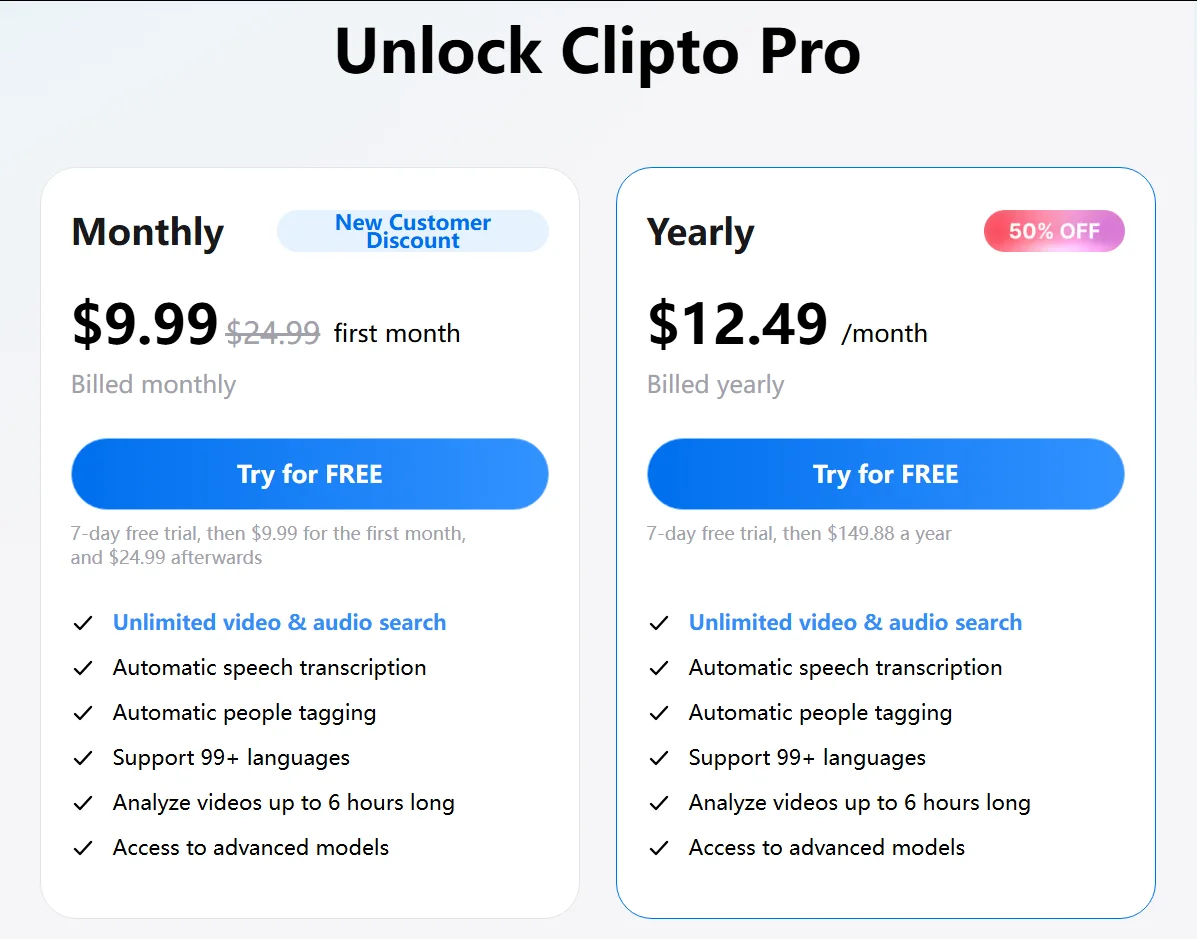
Pricing is subscription-based (exact current tiers should be checked on the site; historical plans have included accessible monthly and yearly Pro options). Enterprise or high-volume professional use will want to evaluate total cost against the time saved in search and retrieval.
Who Should Use Clipto
Clipto is ideal for anyone whose work generates or depends on large volumes of video, audio, and related documents and who values privacy or simply cannot upload everything to the cloud. Video creators and editors, product and research teams, journalists, academics, analysts, and serious knowledge workers will see the largest gains. Teams already experimenting with agentic workflows will find MCP particularly compelling because it finally gives those agents a trustworthy private media memory.
It is less necessary for pure text knowledge bases or users who already live entirely inside tightly integrated cloud ecosystems with strong native search.
The Product Hunt Verdict
Clipto is building the missing memory layer for the agentic era — private, multimodal, local-first, and agent-accessible. The core search product already solves a real daily pain for people drowning in their own media. The MCP launch elevates it from a powerful personal tool into infrastructure that other AI systems can safely use. Performance on modern hardware is impressive, the privacy model is coherent, and the use cases map cleanly to high-value professional work.
In a landscape still dominated by cloud-first AI, Clipto’s insistence on starting where the data already lives feels both principled and strategically smart. For Product Hunt makers building the next generation of agents, creative tools, or knowledge systems, Clipto is worth serious evaluation — both as an end-user product and as a potential memory backend via MCP. It does not try to be everything. It tries to be the reliable, private memory that everything else can finally rely on. That is a focused and timely ambition, and the product is already delivering on it.